The demand for local warehousing continues to grow. However, the available plots and properties in urban areas are rarely suitable for typical modern warehouse designs. This challenge has forward-thinking developers looking up and crunching the numbers to see if a multi-story warehouse is viable.
In this blog, we’ll explore how multi-story warehouses work, where they’re being built, and their potential as a new type of industrial property. We’ll end with examining whether or not these impressive structures make sense within the wider Twin Cities metropolitan area.
What is Multi-story Warehousing?
Let’s start by defining this emerging industrial property category. Multi-story warehousing is just what it sounds like - a warehousing operation that operates across multiple floors. This is in contrast to typical modern warehouses, which operate on a single floor/story, sometimes with footprints that cover hundreds of acres.
Why are Multi-story Warehouses Increasingly Common?
While still an unusual sight in the United States, multi-story warehouse projects have been slowly picking up steam as a better way to serve a particularly tricky and demanding niche - urban last-mile fulfillment.
Urban areas are densely populated and represent a huge amount of purchasing power. However, they also lack the large, open plots of land that are favored for developing traditional fulfillment centers. Relying on out-of-town warehouses can drive up delivery times, while using many disparate small warehouses to handle last-mile delivery can be costly and difficult to manage. A multi-story warehouse design may help operations capture the best of both worlds - capacity equal to or greater than an out-of-town warehouse, plus the efficiency of a central urban location.
How do Multi-Story Warehouses Work?
Multi-story warehouses usually use ramps reminiscent of those used in multi-level parking structures to move delivery trucks and material handling equipment (MHE) from floor to floor. They also feature stairs, elevators, and other vertical lifting equipment for moving personnel and inventory between levels. Loading docks can be built on each floor, with one popular model being to divvy up traffic with smaller trucks serviced by the upper-floor docks, and larger semi-trucks serviced by the main-floor docks.
Examples of Successful Multi-story Warehousing
While the multi-story model has been widely used in East Asian metropolises for decades, these operations typically only have to concern themselves with smaller delivery and transport vehicles than those used in the US. As for American multi-story warehousing, there have been a few prominent developments over the past ten years.
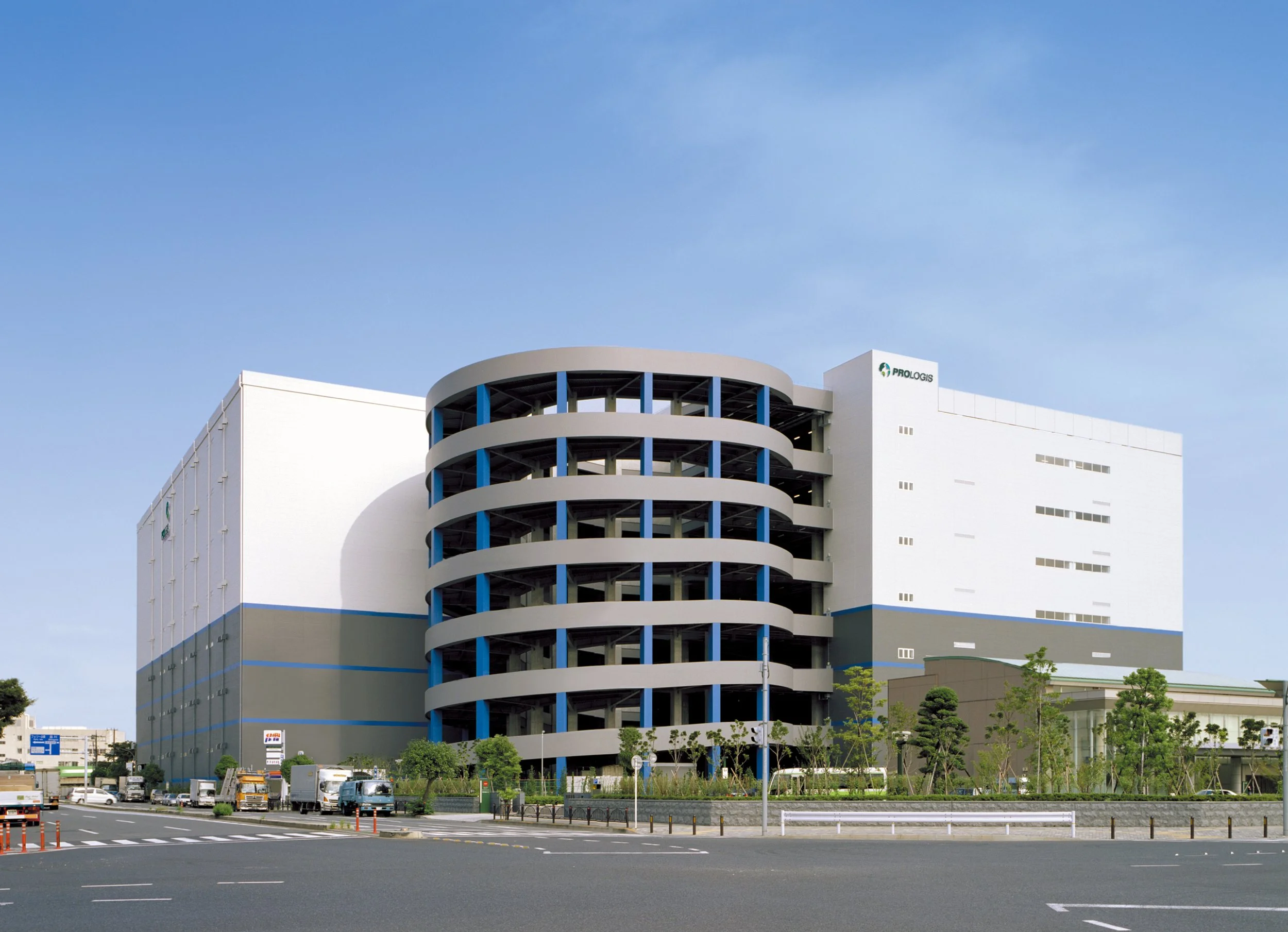
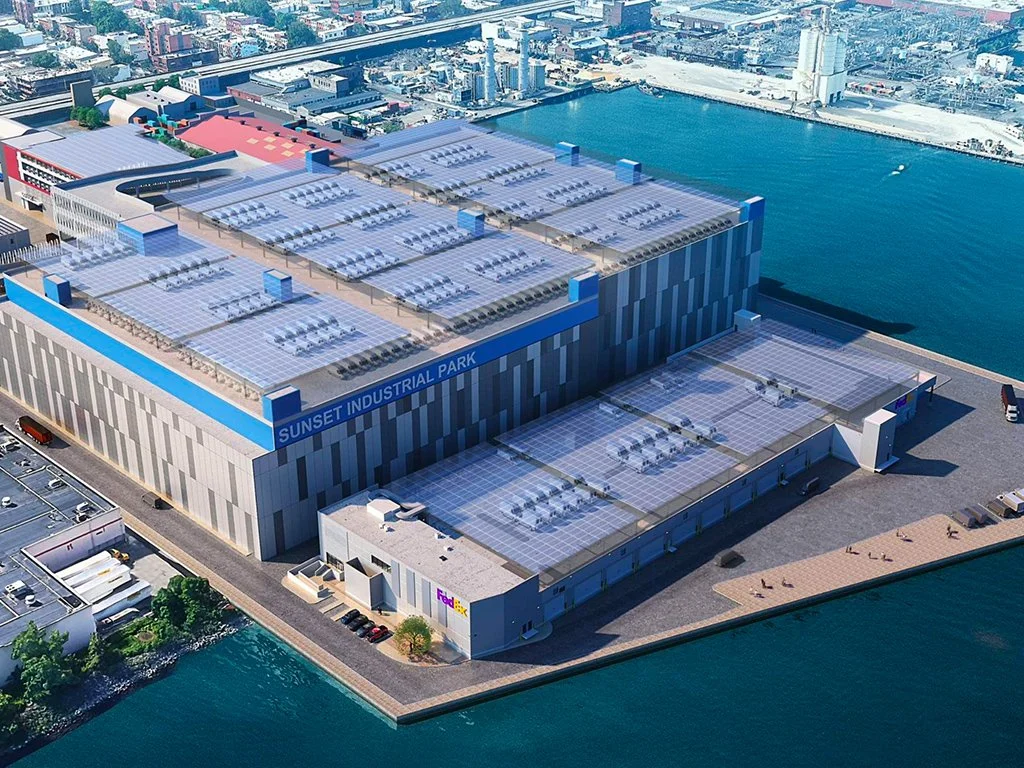
Another major project still underway is the Sunset Industrial Park, a four-story warehouse project in Brooklyn, NY projected to house 1.4 million sq. ft. upon completion.
Photo courtesy of DH Property Holdings
What are the Challenges of the Multi-story Warehouse Approach?
The greatest challenge posed by multi-story warehouses is simply how much more expensive to build and manage compared to conventional warehouses. Their construction requires stronger materials and extremely robust structural engineering to ensure they will withstand the forces placed on them during their lifetime.
Another, more logistical challenge comes down to building regulations. Many municipalities impose more restrictive regulations on taller structures to ensure they’re structurally sound. Regulations like setbacks and utility draws can also be a greater issue when building in close proximity to other established structures in an urban environment, not to mention the density of truck traffic that comes with these operations.
How are Robots and Automation Used in Multi-Story Warehouses?
Much of the MHE employed in multi-story warehousing facilities is robotic, allowing for greater efficiency and automated inventory control across all floors.
The Potential for Multi-Story Warehousing in Minnesota
Though local industrial leasing demand has slowed a bit in recent years from its peak, it continues to be strong. Warehouse availability is also relatively scarce throughout the more densely built-up Twin Cities metro area. Together, these conditions may make Minnesota seem like a fruitful opportunity for this new type of operation, but so far, that hasn’t been the case.
Amazon did propose a multi-story warehouse in Brooklyn Park; however, their proposal was ultimately rejected. The reality is that multiple factors, including the demand for warehouse space, cost of land, and ultimate rents that can be achieved, all have to line up perfectly to make multi-story development a logical investment. Cities where such projects have already been initiated, like NYC and Seattle, have far more challenging terrain and/or population density than the Twin Cities. So, while we may see multi-story warehousing at some point in the future, it would likely be purpose-built and only when conditions are ripe. Still, it’s a possibility worth keeping an eye on as the dynamics of the last mile continue to evolve in this region.
Whatever your industrial real estate needs, Modern CRE’s local expertise and top-of-the-line services will ensure your operation’s success. Contact our team to learn more about what Modern CRE can do for you.